Status: 🔒 This project is currently private as it was my final college project.
I plan to make it public once a new build is ready.
In the meantime, you can access my publication PDF for this project here: Download PDF
🎯 Business Context & Goals
- Explore how data and machine learning can support decision-making in competitive gaming.
- Provide players with a simple tool to reason about team composition and win probability.
- Demonstrate the practical application of ML techniques in a popular MOBA title.
🧩 My Role & Responsibilities
- Defined the problem, collected and labeled match data, and chose the modeling approach.
- Implemented the Naive Bayes-based prediction logic and analytical workflows.
- Designed a simple user interface concept for players to interact with the model.
📊 Impact & Outcomes
- Created an educational tool that raised awareness of how composition and strategy affect outcomes.
- Showcased ML skills in a domain that is easy to relate to for many users.
- Served as a strong academic capstone, demonstrating end-to-end data science ability.
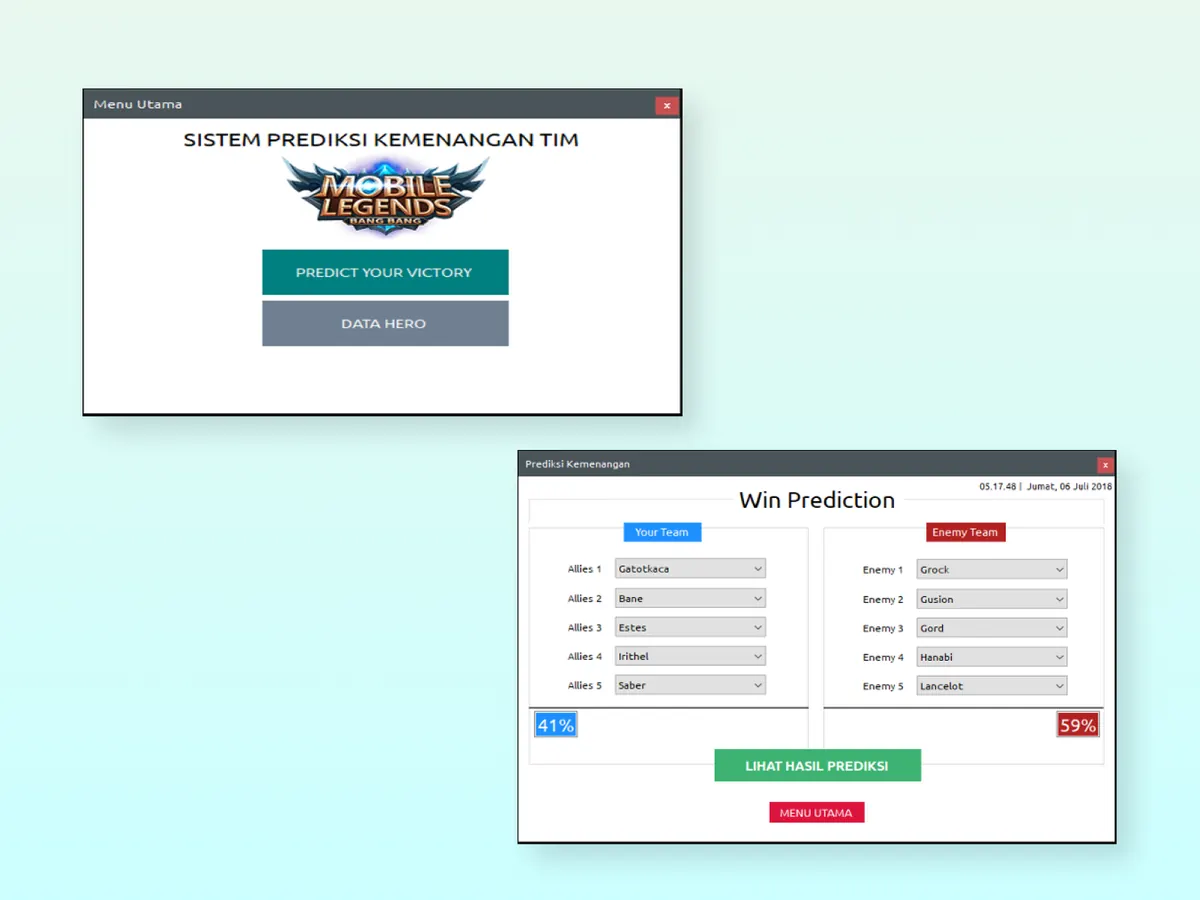
I developed a machine learning-based prediction system to estimate team win probability in Mobile Legends: Bang Bang, a popular MOBA mobile game. The system utilized the Naive Bayes algorithm to classify and calculate the winning likelihood of a team based on hero composition and several critical factors such as role synergy and build strategies.
💻 Tech Stack
- Tools: MATLAB
- Algorithms: Naive Bayes
🔍 Key Objectives
- Help players understand win potential based on their team’s composition.
- Provide a decision support system for better hero selection and strategy planning.
- Highlight the importance of teamwork, hero mastery, and item builds in ranked matches.
🛠 What I Did
- Collected and labeled gameplay data from 30 real matches.
- Identified key loss factors: poor team composition, incorrect item builds, and lack of hero mastery.
- Applied the Naive Bayes classification algorithm to calculate win probabilities.
- Created a user interface (as a prototype) where users input team composition and receive win chance predictions.
- Modeled user flow using Use Case Diagrams to capture system requirements.
📊 Outcome
- Built a lightweight and educational prediction tool that served as a guide for strategic gameplay.
- Demonstrated how machine learning could enhance user decision-making in competitive games.
- The project received strong academic feedback and showcased the applicability of data science in game environments.
🧩 Challenges
- Limited dataset (30 matches) required thoughtful data preparation and assumption handling.
- Translating complex in-game variables into measurable and meaningful inputs for the model.
📁 Deliverables
- Complete dataset and preprocessing scripts.
- Functional prototype of the prediction system.
- Final report and academic presentation.